Gallery
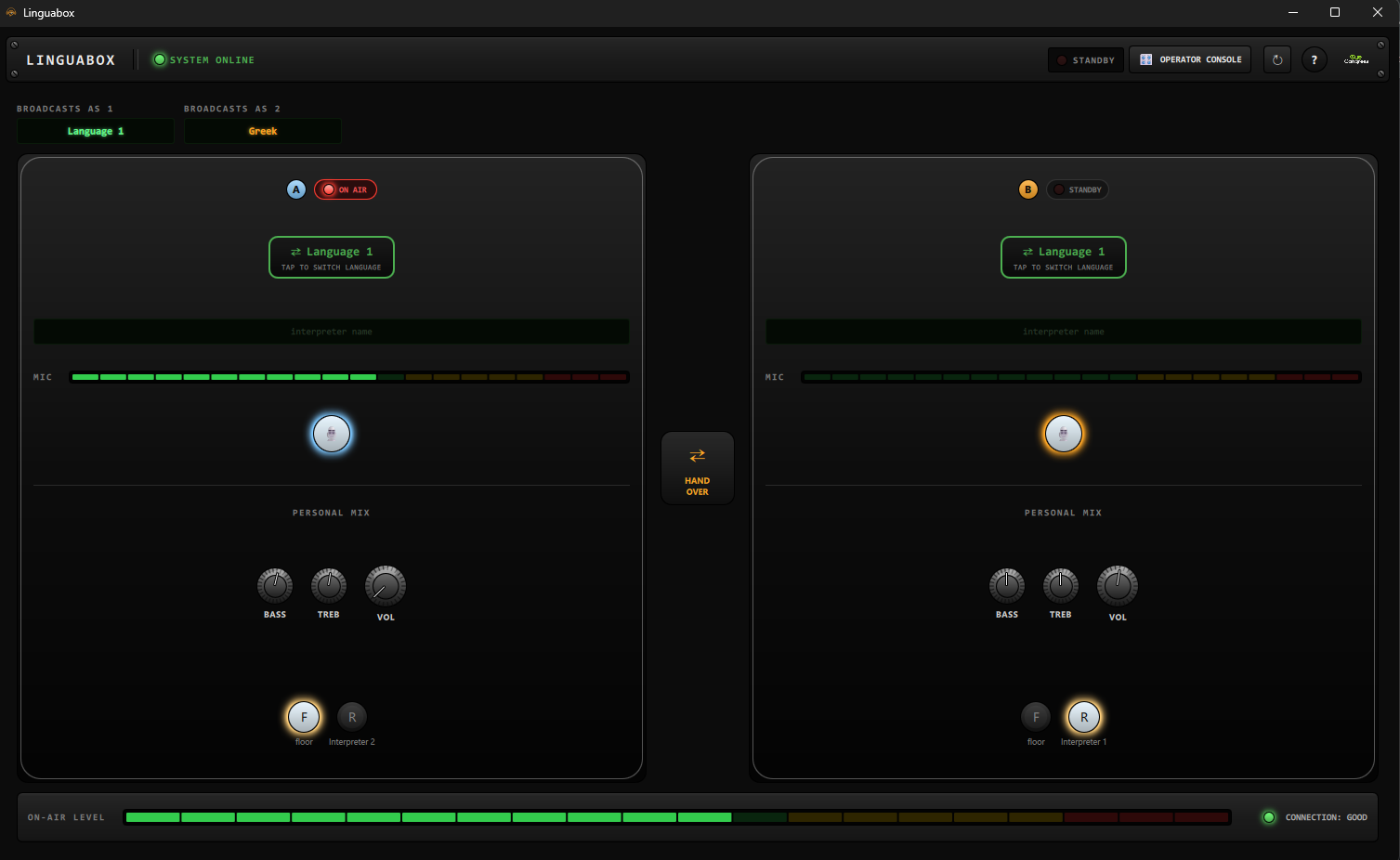
Operator Console — two-interpreter cabin control with live on-air/standby status, personal mix, and handover
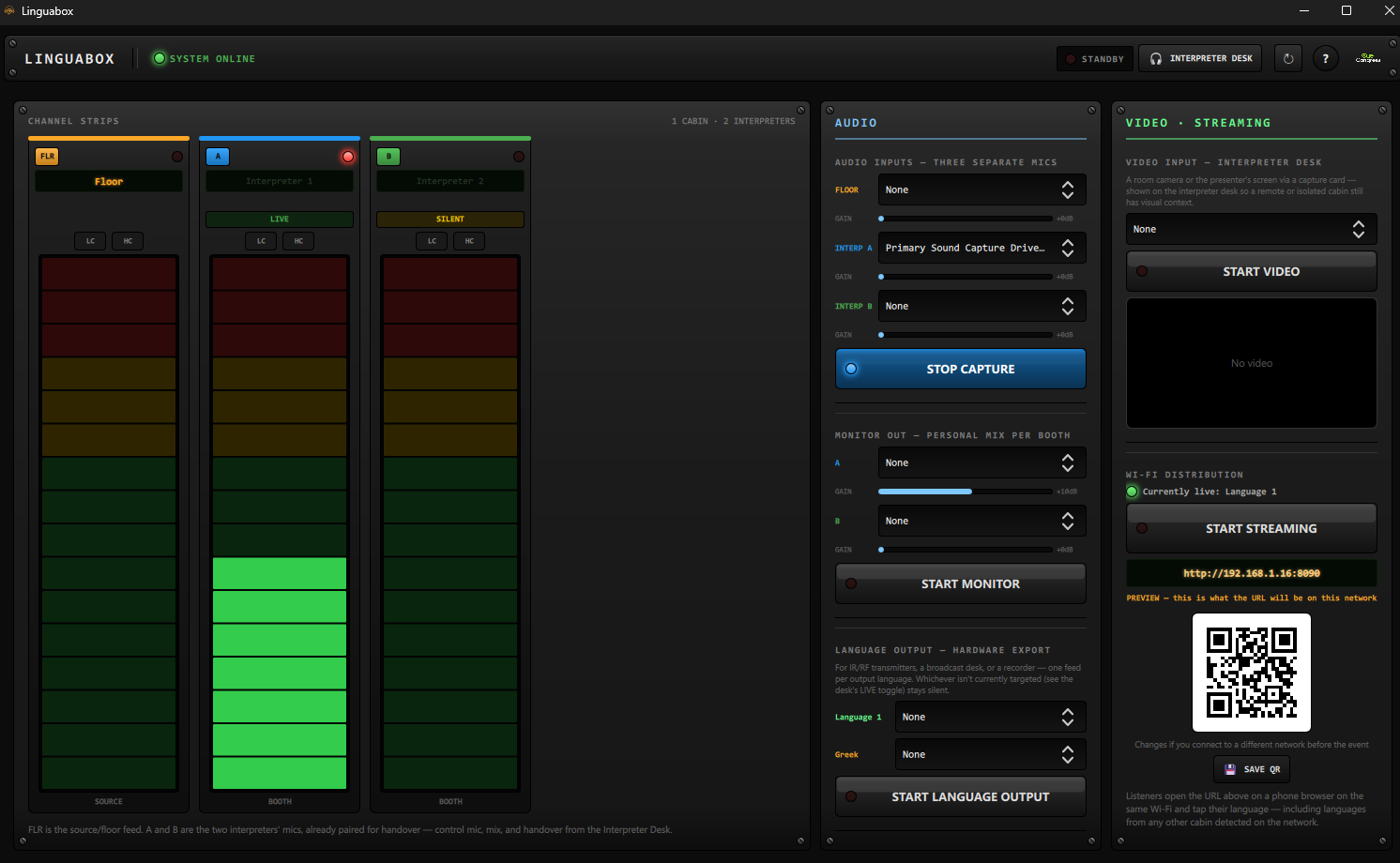
Settings — audio inputs, monitor mix, hardware language output, video input, and Wi-Fi distribution with join QR code
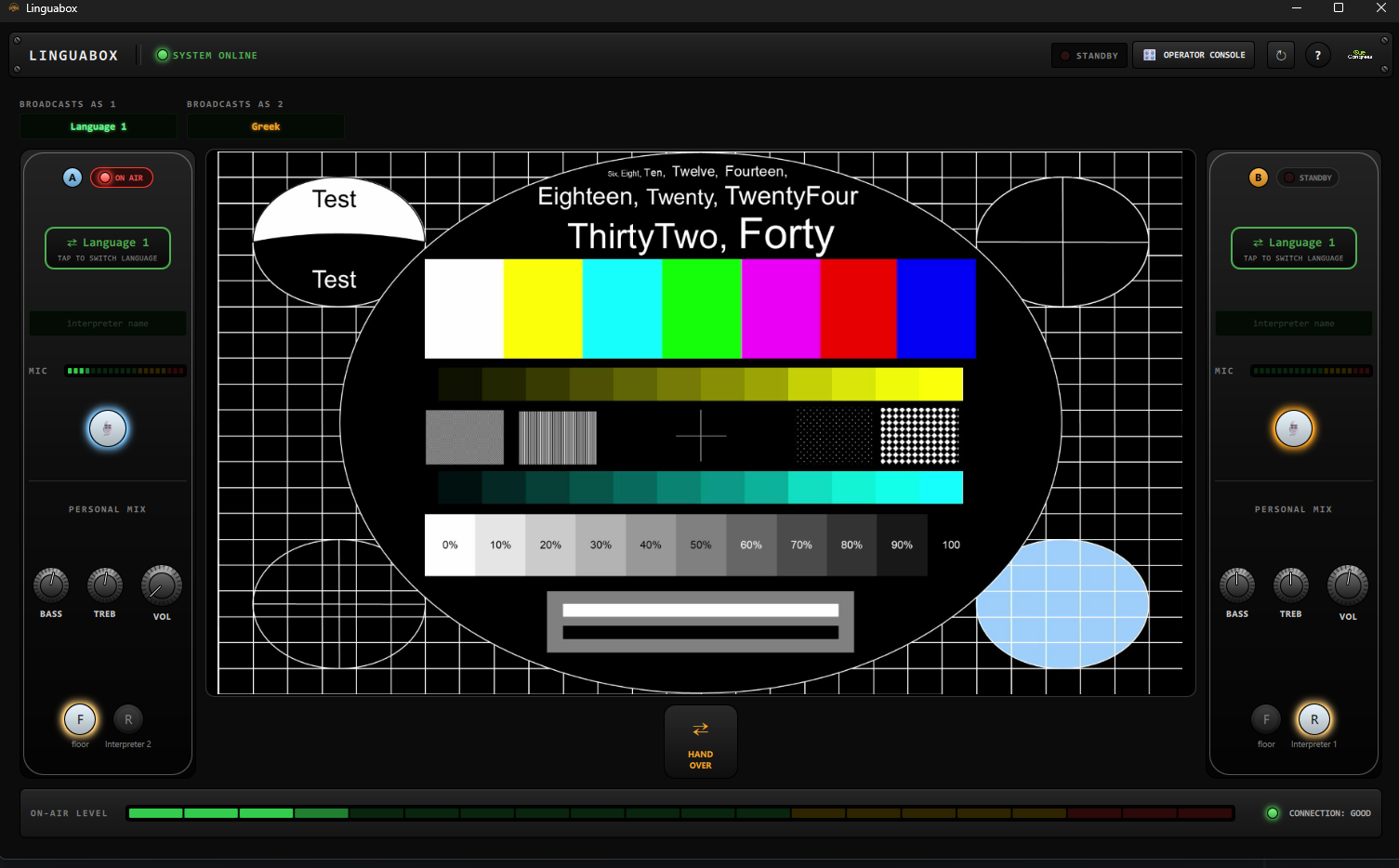
Interpreter Desk Video — a room camera or capture-card feed shown live for cabin context
A Cabin Console, Not Just a Streaming Box
Most low-cost interpretation setups are just an audio relay — mic in, stream out. Linguabox is built around how a real two-interpreter cabin actually works: tag-team handover between interpreters, a floor-or-relay choice for what each interpreter listens to, and a language output that can flip live without dropping the feed, all from one console.
Key Features
Two-Interpreter Cabin Control
Interpreters A and B are paired for handover out of the box — mic, personal mix, and on-air status for both live side by side on one desk.
Bidirectional Language Output
Two independent language outputs, one shared switch. When the floor speaker changes language, flip the toggle and both the room feed and the Wi-Fi stream follow instantly — nothing needs replugging.
Floor / Relay Monitoring
Each interpreter picks what they hear: the original floor speaker, or a relay from the other interpreter's channel — the standard setup for relay interpretation.
Wi-Fi Distribution to Any Phone
Listeners join over your venue Wi-Fi from their own phone's browser — no app install. A QR code on the console gets them in, and they simply tap their language. For larger audiences, a dedicated professional router gives far more reliable capacity and range than shared venue Wi-Fi.
Multi-Cabin Discovery
Run more than one cabin on the same network and Linguabox finds the other cabins automatically — listeners see every available language from every cabin on one shared page, no central server required. A standard license activates on 2 devices, supporting up to 2 cabins at once.
Handover Fatigue Guidance
Following AIIC-style guidance, the desk nudges a swap around 25 minutes on duty and flags it clearly past 35 — a quiet reminder, not a hard interruption.
Video on the Desk
Pipe a room camera or a capture-card feed of the presenter's screen straight to the interpreter desk, so a remote or isolated cabin still has visual context.
Per-Channel Tone Shaping
Low-cut and high-cut filtering plus adjustable gain on every mic input — clean up rumble, tame hiss, or boost a quiet source before it ever reaches the mix.
Personal Monitor Mix
Each booth gets its own headphone mix with independent bass, treble, volume, and gain — dialed in per interpreter, not shared.
Hardware Language Output
Route either language out to physical hardware — an IR/RF transmitter, a broadcast desk, or a recorder — independent of what's happening on Wi-Fi.
Independent Recording
Record the on-air interpreted audio to a WAV file whether or not any listener is connected, and whether or not streaming is running.
Emergency Alert Broadcast
Push a text alert straight to every connected listener's screen for evacuation notices or technical announcements.
Perfect For
- Conferences and congresses with live interpretation
- Corporate events needing multiple language tracks
- Panel discussions and multi-speaker sessions
- Venues running more than one interpretation cabin at once
- Any event where listeners need to bring their own device instead of a rented receiver
System Requirements
- Windows: Windows 10 or later (64-bit)
- macOS: Coming Soon
- RAM: 4 GB minimum
- Audio: a multi-channel audio interface, or separate USB mics/headsets per interpreter
- Network: a local Wi-Fi network for listener distribution and multi-cabin discovery
- Video (optional): a webcam or capture card for the interpreter desk's video feed